

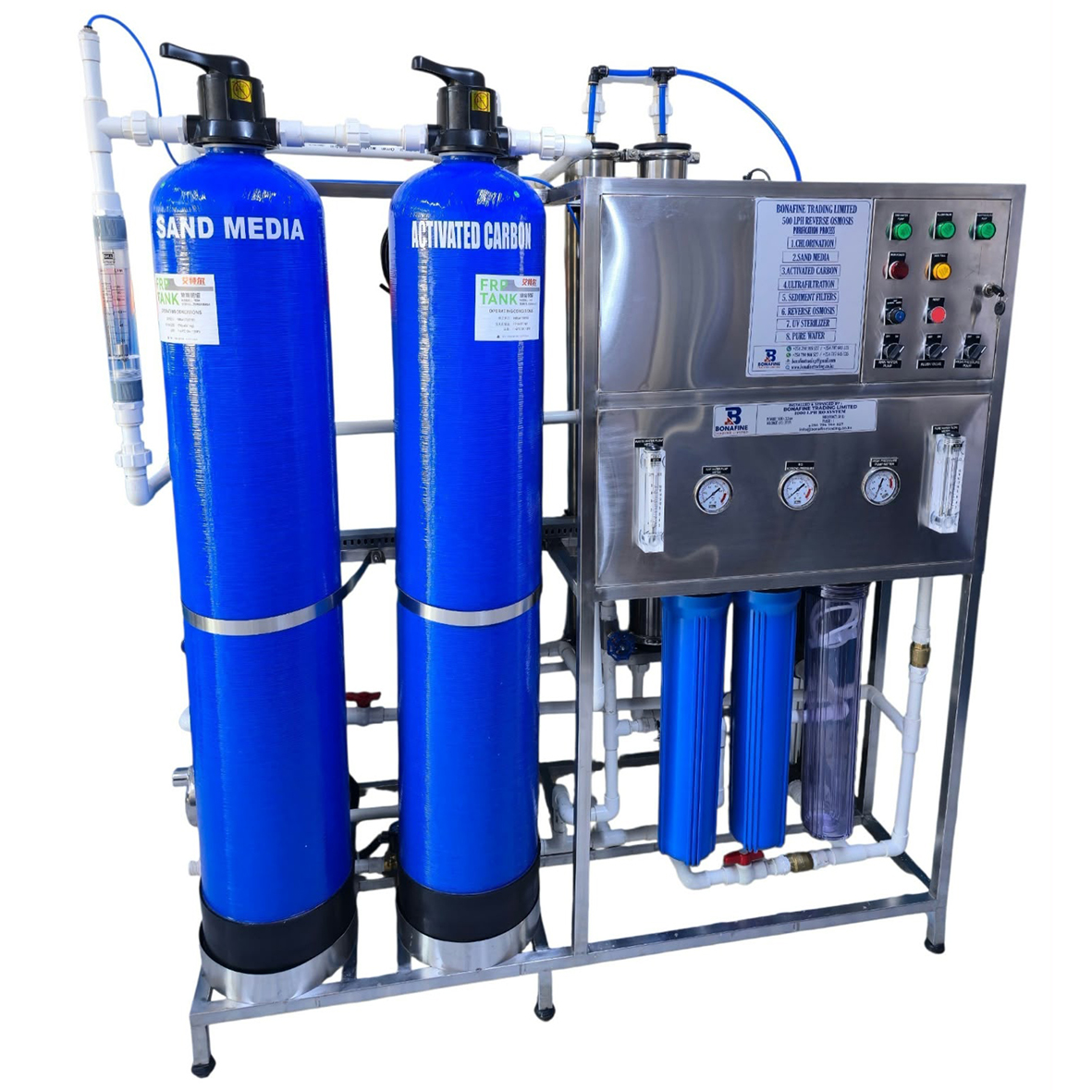
HOW TO PURIFY BOREHOLE AND WELL WATER IN KENYA: THE COMPLETE REVERSE OSMOSIS GUIDE.
If you rely on borehole water in Kenya, you already know that raw groundwater rarely comes out perfect. It may taste salty, smell of Sulphur, stain your sinks orange or simply feel “hard” on your skin and in your kettle.
The good news is that almost every one of these problems has a proven engineering solution and in most cases, a correctly designed reverse osmosis (RO) system sits at the heart of it.
This guide answers the real questions Kenyan homeowners, landlords, hoteliers, hospital administrators, school directors, factory managers and water refill entrepreneurs ask when their borehole water is not fit to drink or use.
We will walk through how to purify borehole and well water, why treatment stages matter and how to size and choose the right RO machine.
Common Borehole and Well Water Problems in Kenya
Kenyan groundwater varies by region. Coastal boreholes (Mombasa, Kilifi, and Malindi) tend to be salty due to seawater intrusion.
Rift valley boreholes (Nakuru, Naivasha parts of Kajiado) often carry high fluoride and sodium bicarbonate levels. Central Kenya and highland boreholes can have high iron, manganese or hardness. Because every borehole is different, the first step is always understanding your water, not by assumption. You just correct one liter sample and take it to a laboratory and request for physical and chemical analysis to help design a machine that best suits your water.
How To Purify Borehole Water for Drinking
The safest and reliable way to make borehole water drinkable is a staged treatment process: Sediment removal then chemical media-based correction for specific contaminants (iron, manganese, hardness, fluoride, followed by reverse osmosis to strip dissolved salts and microorganisms and finally a disinfection or remineralization step before storage. RO alone can achieve excellent results, but it works best and lasts longer when the water reaching the membranes has already been pretreated.
How To Purify Well Water for Drinking
Shallow wells are more exposed to surface contamination than deep boreholes, so biological safety is usually the priority alongside dissolved solids. A common sequence is: Sediment filtration, activated carbon (to remove organic matter, dour and chlorine if pre- chlorinated), reverse osmosis, UV or ozone disinfection as a final safety barrier. This combination addresses both the chemical and microbiological risks common in shallow wells.
How To Remove Salty Taste From Borehole Water
A salty or brackish taste is almost always caused by high Total Dissolved Solids (TDS), sodium and chloride. Reverse osmosis is the most effective technology for this, rejecting 95-99% of dissolved salts. Before installation, a water test confirming TDS and chloride levels helps determine the correct membrane configuration and whether a single-pass or two-pass RO system is needed for very saline water.
How To Remove Fluoride From Borehole Water
Fluoride above safe limits is common in Rift valley boreholes. Standard RO membranes reduce fluoride significantly(often 85-95%) but for very high fluoride levels, activated alumina as a pretreatment or polishing stage boosts removal further. The right approach depends on your lab report showing fluoride level in the raw water.
How To Remove Hardness From Borehole Water
Hardness (calcium and magnesium) causes scaling in pipes, kettles, water heaters and RO membranes. Two approaches work: a water softener(ion exchange)ahead of the RO system to protect membranes and equipment, or antiscalant dosing for moderate hardness where softening is not essential. RO itself removes hardness minerals from the final drinking water, but pretreatment makes them last longer.
How To Soften Hard Borehole Water
Softening uses an ion-exchange resin to swap calcium and magnesium ions for sodium ions, eliminating scale formation.
This is usually recommended as a pretreatment stage for RO systems in hard-water areas and can also serve household plumbing separately from the drinking water line.
How To Remove Iron From Borehole Water
Iron causes orange/brown staining and a metallic taste.
Removal typically uses an iron and manganese removal media filter (such as manganese greensand, DMI 65 or catalytic media), sometimes combined with aeration or oxidation, installed before the RO system.
Iron left untreated can quickly foul RO membranes, so this step is important in iron-rich boreholes.
How To Remove Manganese From Borehole Water
Manganese behaves similarly to iron, causing black staining. It is addressed the same way-through oxidation and specialized filter media before water reaches the RO stage.
How To Remove Colour From Borehole Water
Colour is often linked to dissolve organic matter, iron or manganese.
Flocculation, ultrafiltration membrane and appropriate oxidation/media filtration resolve colour issues.
How To Remove Turbidity From Borehole Water
Turbidity (cloudiness from suspended particles) is handled with sand filtration, sediment cartridge filters and ultrafiltration membrane, always positioned before RO membranes which are easily damaged by suspended solids.
How To Remove Bad Smell From Borehole Water
Oduor, often a rotten-egg smell from hydrogen sulphide or a smell from organic matter, is usually treated with aeration and activated carbon filtration. Chlorination followed by carbon filtration also works well for sulphide oduor.
How To Disinfect Borehole Water
Disinfection can be chemical (chlorine dosing) or non –chemical (UV light or ozone). UV is popular in Kenya because it adds no taste or chemicals and is simple to maintain. It is installed as the final step, right before the purified water enters storage tanks.
How To Remove Sodium From Borehole Water
High sodium is common alongside high TDS and fluoride in certain Kenyan boreholes.RO is highly effective at sodium rejection. In cases with extremely high sodium, two-pass RO configuration improves the final water quality further.
How To Reduce TDS In Borehole Water
RO systems are rated by their rejection rate, commonly 95-99%
For example, water at 1,500 ppm TDS can be brought down to below 50 ppm, well within drinking water guidelines, provided the system is properly sized and maintained.
How To Remove Dissolved Salts From Borehole Water
Dissolved salts (TDS) pass through most sediment filters but are captured by the semi-permeable RO membrane. This allows only water molecules through under pressure while rejecting the majority of dissolved ions.
How To Make Salty Borehole Water Safe For Drinking
Combine sediment pretreatment, antiscalant dosing (to protect membranes from scale in saline water) a correctly sized RO system and post-treatment remineralization for taste. This produces safe, pleasant tasting drinking water even from saline water source.
How To Treat Borehole Water For Apartments
Apartment blocks need enough daily volume for many households plus adequate storage tanks to handle peak morning and evening demand. Systems in the 500-2000 LPH range are common, size against the number of units and average per-person consumption.
How To Treat Borehole Water For Hotels
Hotels need to account for guest rooms, kitchens, laundry and sometimes swimming pools. Systems range from 1,000-5,000 LPH depending on the hotel size.
How To Treat Borehole Water For Hospitals
Hospitals have strict quality requirements, especially for microbiological safety and may need RO water for specific medical uses in addition to general drinking and utility water.
Backup capacity (redundancy) and validated disinfection stages are especially important here.
How To Treat Borehole Water For Schools
Schools need reliable, low-maintence systems capable of serving large numbers of students during short peak periods(break times, meal times). Adequate storage capacity often matters as much as machine capacity.
How To Treat Borehole Water For Factories
Factories may need purified water for production process as well as staff welfare and process water specifications can be stricter than drinking –water standards. Industrial RO systems from 2000LPH upward, often with pretreatment specific to the factories raw water, are common.
How To Treat Borehole Water For Water Refill Businesses
Water refill and bottled-water businesses need consistent, high-volume output and dependable membrane performance since this is the core of the business. Capacities from 250LPH to 5000 LPH are common, matched to expected daily sales volume and operating hours.
How To Choose The Right Reverse Osmosis Machine For Borehole Water
The right machine depends on five factors: your raw water quality (from lab testing), your daily water demand, your peak-hours demand, how many hours per day you plan to run the system and your storage tank capacity. A correctly matched system avoids both under-sizing (running out of water at peak times and over-sizing (paying for capacity you don’t need)
How To Know What Size RO Machine You Need
A simple starting formula: Daily water demand÷planned daily operating hours = required LPH capacity. For example, a hotel needing 8,000litres per day, running the machine for 8 hours daily, needs a machine rated at roughly 1,000LPH with some safety margin added for peak demand and future growth.
How To Know Whether Borehole Water Requires Reverse Osmosis
Not every borehole needs RO. If lab report shows acceptable TDS,hardness and no harmful contaminants, simpler filtration and disinfection may be applicable. RO becomes necessary when water thresholds. Or when a business needs constituently low-mineral water for specific purpose (like bottling or certain industrial processes). Where RO is not needed we use a general use/general purpose water purifier.
How To Test Borehole Water Before Installing An RO Machine
A certified water testing laboratory in Kenya(such as those affiliated with KENAS,KEBS-recognized labs,WASREL,or university water quality labs) should analyse your borehole sample for TDS,PH,fluoride,sodium,chlorides,hardness,iron,manganese,turbidity,colour,alkalinity,sulphates,nitrates(physical and chemical analysis)and microbiological test. This report is the single most important document for designing your treatment system correctly.
How Does A Reverse Osmosis Machine Purify Borehole Water?
Reverse osmosis works by pushing raw water under pressure through a semi-permeable membrane with pores fine enough to block dissolved salts, heavy metals, bacterial and most contaminants, while allowing purified water molecules to pass through. The complete treatment process generally look like this:
- Raw water intake – Water is drawn from the borehole or well into a holding tank.
- Pretreatment – Sediment filtration removes suspended particles, media filters address iron, manganese or hardness as needed.
- Sediment/cartridge filtration – a filter polishing stage protects the RO membranes from fine particles.
- Antiscalant dosing (where needed) – prevents scale buildup in membranes in hard or high-mineral water.
- RO membrane stage – High pressure pump forces water through the membranes, separating purified water (permeate) from concentrated reject water.
- Disinfection/post-treatment – UV sterilization, ozone or chlorination provides a final microbiological safety barrier. Remineralization can be needed to improve taste.
- Purified water storage – Treated water is held in a clean storage tank ready for distribution.
How Much Does A Borehole Water Purification System Cost In Kenya
Costs vary widely depending on raw water quality, required. Capacity, pretreatment needs and automation level. A small household system costs for less than an industrial system for a factory or water refill business. Because pricing depends heavily on your specific water analysis results and daily demand, Bonafine Trading Limited provides tailored quotations once your water test and requirements are known.
Why A Water Analysis Report Is Important Before Buying an RO Machine
It’s tempting to assume that borehole water needs RO with all the extra stages, but every source is different, a proper laboratory report tells you exactly which contaminants are present and at what concentration, so you only pay for the pretreatment stages you actually need. Skipping this step risks either an undersized system that fails to solve your problem, or an oversized, unnecessarily expensive one. Bonafine Trading Limited recommends customers to share their lab report (or use Bonafine’s water testing guidance before finalizing a system design.
Choosing Between A Smaller RO Machine Running Longer Vs A Larger Machine Running Shorter
A small RO machine running many hours a day costs less upfront but increase wear on pumps and membranes and offers less flexibility if demand spikes. A larger machine that meets your daily requirement within fewer operating hours costs more initially but reduces daily runtime, extends component life and better handles peak demand or future growth. The right choice depends on your budget, expected demand pattern and how critical uptime is to your operation.
| PARAMETER | WHY IT MATTERS |
| TDS | Overall dissolved mineral/salt content, it affects taste and RO sizing
|
| Electrical conductivity | It indicates dissolved ion concentration, closely tied to TDS. |
| PH | Affects corrosively, scaling tendency and taste. |
| Fluoride | Excess levels are a health concern, needs targeted reduction. |
| Sodium | Contributes to salty taste and health considerations for restricted diets. |
| Chlorides | Contributes to salinity and corrosiveness.
|
| Total hardness | Causes scaling; needs softening and antiscalant treatment. |
| Calcium and magnesium | Primary hardness, causing minerals. |
| Iron | Causes black staining, similar treatment to iron. |
| Turbidity | Cloudiness from suspended solids, damages RO membranes if untreated. |
| Colour | Often linked to organics, iron or manganese. |
| Bicarbonates/alkalinity | Affects scaling potential and PH stability. |
| Sulphites | Can affect taste and contribute to scaling. |
| Nitrates | Indicates possible contamination, health concerns at high level. |
| Microbiological contamination | Bacteria and pathogens requiring disinfection. |
Reverse osmosis effectively removes dissolved salts, most heavy metals and microorganisms, but parameters like high iron,manganese,hardness,turbidity and certain organics are better addressed through dedicated pretreatment, protecting your membranes and improving overall system performance.
Frequently Asked Questions (FAQ)
1. Can reverse osmosis machine remove all borehole water problems on its own?
Not always.RO is highly effective for dissolved salts, fluoride, sodium and microorganisms but iron, manganese, hardness and turbidity are best addressed with pretreatment first to protect the membranes and improve results.
2. How often do RO membranes need replacement?
This depends on raw water quality and usage but well pretreated systems normally need membrane replacement every 6 months – 2 years with sediment and carbon filters changed more frequently.
3. Is RO treated water safe to drink long-term?
Yes, when properly maintained and where needed, remineralized for taste and mineral balance.
4. Does RO waste a lot of water?
Some reject/concentrate water is produced during the process, recovery rates of 40 -85% are normal and reject water can be repurposed for irrigation or other non-drinking uses.
5. Can I use an RO system without electricity backup?
Most systems require a stable power supply, a generator or inverter backup is recommended for continuous operation, especially for businesses.
6. How do I know if my borehole water is salty?
A laboratory TDS and conductivity test will confirm salinity levels. A salty taste is usually a strong indicator at elevated TDS and chlorides.
7. What is a good TDS level for drinking water?
Generally, TDS below 100ppm is considered acceptable for taste and health, though guidelines vary, your lab report should be compared against drinking water standards.
8. Can RO remove fluoride completely?
RO reduces fluoride but may not remove 100%. Activated alumina can be added for higher removal where fluoride levels are very high.
9. Do I need a water softener if I already have RO?
If your raw water is very hard, softening protects your membranes from scaling and extends their lifespan.
10. How do I choose between 250LPH and 500LPH system?
Compare your daily water demand and desired operating hours. If your demand exceeds what a 250LPH unit can produce within your available hours, move up to 500LPH .Sometimes, TDS is also a factor, use 500LPH where TDS is higher to improve product quality and lifespan of the machine.
11. What test should I request from a lab report?
Just collect one litre sample and take it to a lab for testing and request for physical, chemical and microbiological analysis.
This will help in getting the levels of parameters like TDS,TSS,PH,conductivity,colour,turbidity,iron,manganese,sodium,chlorides,total hardness,fluoride,bacteria etc.
12. Can a factory use the same RO system for both drinking water and production?
This depends on the required water specification for the production process, some factories need separate systems if process water standards differ from drinking water standards.
13. How long does it take to install an RO system?
Installation timelines vary the system size and the site readiness but most residential and small commercial systems can be installed within a few days once the design is finalized.
14. Does hard borehole water damage RO membranes?
Yes, untreated hardness causes scale buildup on membranes reducing efficiency and lifespan, which is why pretreatment or antiscalant dosing is recommended for hard water.
15. Can I test my own borehole quality without a lab?
Basic TDS meters give a quick indication, but a full laboratory analysis is necessary for accurate system design, especially for hardness, fluoride, iron, heavy metals and microbiological safety.
16. What’s the difference between an RO plant and an RO machine?
The terms are often used interchangeably;”RO plant” is sometimes used for larger industrial/commercial installations while “RO machine” can refer to any scale.
17. Do water refill businesses need a bigger RO system than homes?
Yes, refill businesses need continuous, high volume output compared to residential systems.
18. How do I maintain an RO system for a hotel or hospital?
Regular filter and membrane replacement, periodic water testing and scheduled cleaning or treatment media are essential, especially where constituent water quality is critical.
19. Is UV sterilization necessary if I already have an RO?
UV adds an important extra barrier against microorganisms especially valuable for shared or commercial water supplies, even though RO membranes already provide strong microbiological rejection.
20. Can Bonafine Trading Limited help design a system based on my water test analysis?
Yes, Bonafine Trading Limited recommends sharing your laboratory water analysis report so that the correct treatment stages and RO capacity can be specified for your specific borehole or well.
21. Which is the best machine to purify borehole water with a TDS above 10,000ppm?
Bonafine Trading Limited recommends a sea water desalination system for water with TDS of above 10,000ppm.It offers a higher rejection rate therefore producing purified water with lesser TDS.
Get The Right System For Your Borehole Or Well
Every borehole tells different story and the right water treatment plan starts with knowing exactly what is in your water. Bonafine Trading Limited designs and installs reverse osmosis and complete water purification systems for homes, apartments, hotels, hospitals, schools, factories and water refill businesses across Kenya. The machine is correctly sized using your water analysis results and daily consumption.
Get in touch with Bonafine Trading Limited:
Website: www.bonafinetrading.co.ke
